
Your business deserves its own address. ebz.app gives any small business its own page at ebz.app/your-name, set up in one sitting on a phone, then the everyday tools to run it: team, dashboards, daily takings, content and workflows. CRM, ERP and AI collaborators join the same account as the business grows. This article is both the brochure and the full product specification: architecture, security, operations and technical stack.
In short
- What it is: the hosted edition of Ebiz Suite, the business suite for SMEs. A business signs up, gets its own address and runs on the suite with nothing to install.
- Who it is for: owners of small and mid-sized businesses of every kind: shops and e-Shops, tutors and coaching centers, restaurants and cafes, and, on the same engine, traders, travel agents, lodges, transport operators, exporters and repair services.
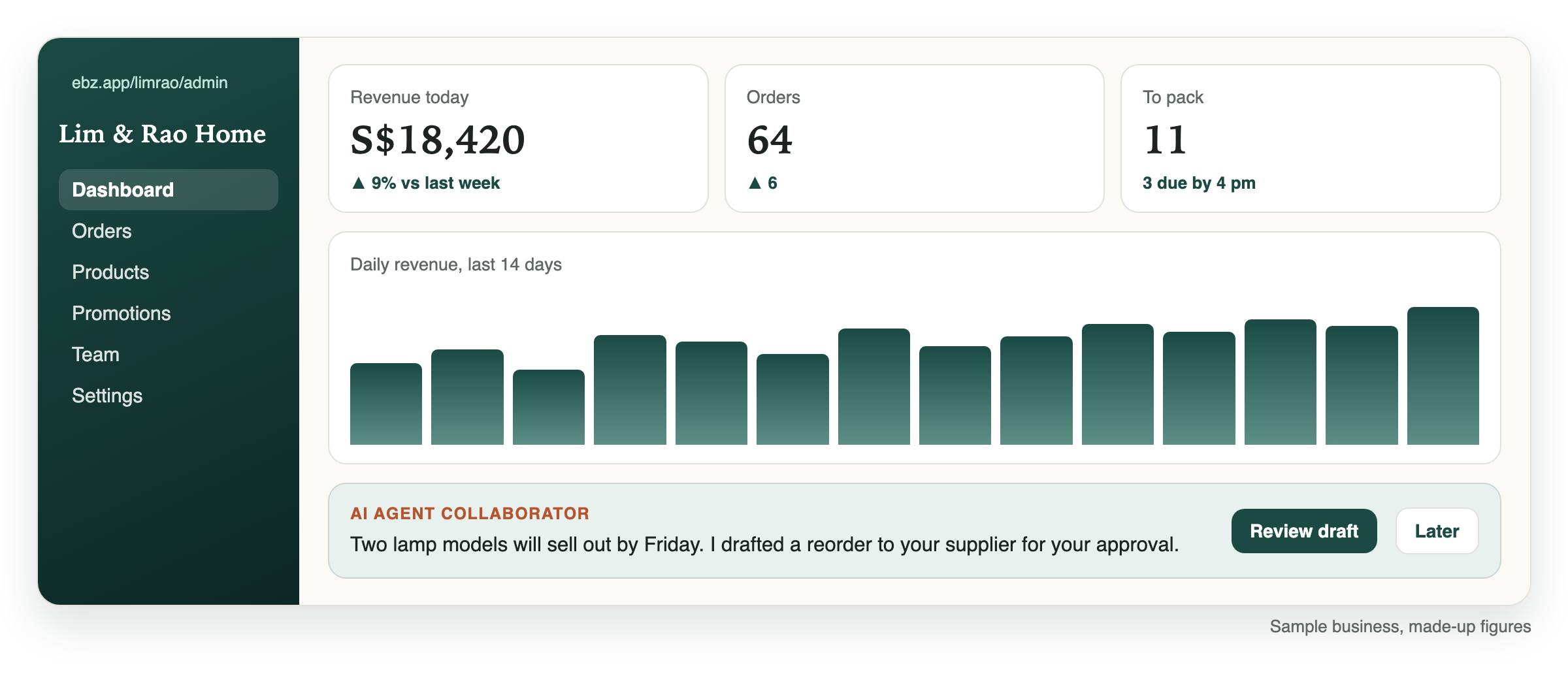
- What you get: your own short link, a page in a look made for your kind of business, orders and bookings, payments straight to your own account, a team with roles, dashboards and a daily file for your accountant.
- Why you can trust it: it is built on the Secure Agent Platform: passkeys instead of passwords, every business's data kept apart, and a record of every action.
Your business deserves its own address
Most small businesses go online by renting space on someone else's platform: a marketplace listing, a delivery app or a booking site. The platform owns the customer, takes a commission on every order, and decides how the business looks. ebz.app turns that around. Each business gets its own address, such as ebz.app/kaveritraders, its own page in its own colors, and its own customers. Payments go straight from the customer's bank to the business's bank, and the business's data stays the business's, downloadable at any time.
ebz.app and Ebiz Suite: product and service
Ebiz Suite is the product: the full set of capabilities, with kind profiles for many industries, the modules for sales, catalog, payments, people, CRM, inventory, analytics and AI, and the integrations to other systems. ebz.app is the service: the hosted edition a business signs up for, which turns the suite into something a real business uses every day. A good product on a weak service fails in its first week, so the service carries as much design as the product: the address and routing, sign-up and approval, the trial and its renewals, the legal documents per country, the operator's console, hosting, monitoring, the release pipeline, and the switches that stop trouble fast.
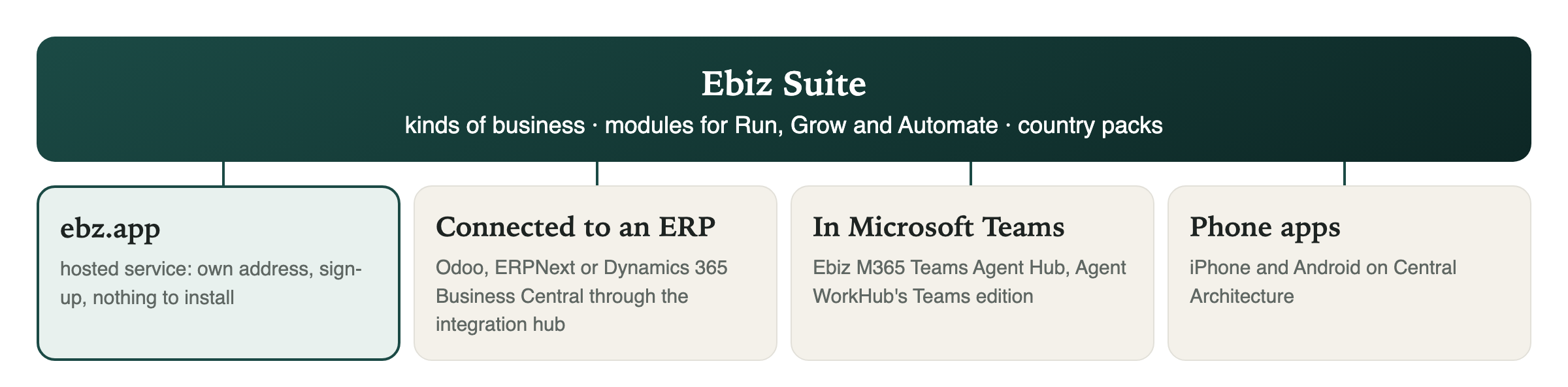
A house for every kind of business
Pick your kind at sign-up, and the screens, words and starter catalog follow. A tutor sees courses, batches and admissions; a shop sees products, stock and delivery; a restaurant sees a menu with choices, table QR ordering and a kitchen board. One engine serves them all, so every improvement reaches every kind of business.
- Shops and e-Shops: products, stock, delivery and returns.
- Tuition and coaching: courses, batches, admissions and fees.
- Restaurants and cafes: menu with choices, table QR ordering, kitchen board.
- Trading and wholesale: price lists, quotations, orders and credit.
- Travel and tours: packages, bookings, itineraries and deposits.
- Lodges and homestays: rooms, bookings, check-in and guest requests.
- Taxi and transport: trips, drivers, vehicles and fares.
- Exporters: pro forma invoices, currencies and shipping documents.
- Services and repairs: appointments, jobs, technicians and bills.
ebz.app opens kind by kind in each country, each one checked with real businesses of that kind first. In Australia, shops and e-Shops and tuition and coaching businesses sign up at ebz.app/au; in Singapore, restaurants and cafes join them at ebz.app/sg.
Five steps, one sitting
The real registration, on your phone. Each step has a Back button, and the whole journey takes one sitting.
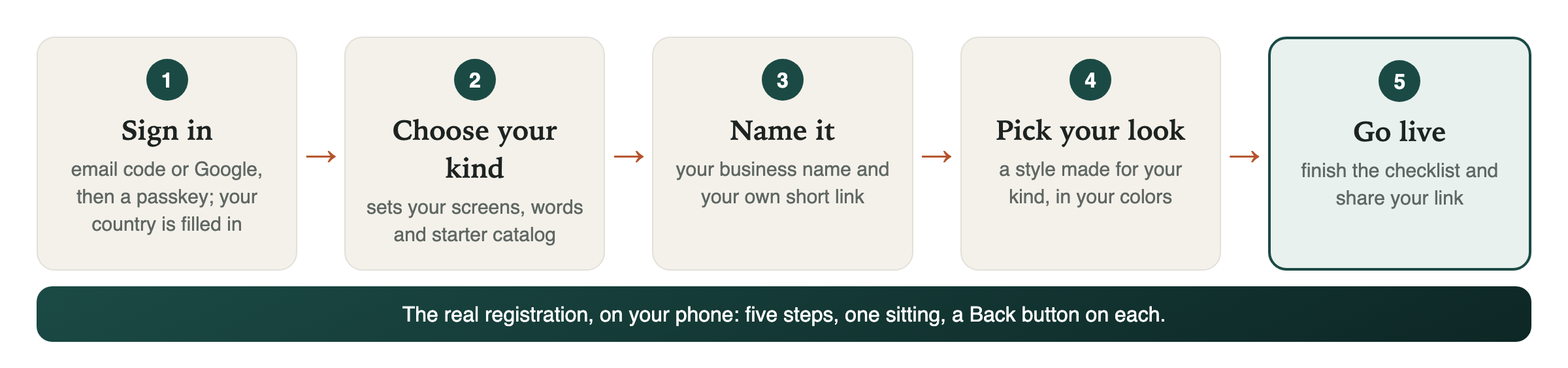
- Sign in with an email code or Google, then save a passkey. Your country is filled in.
- Choose your kind. It sets your screens, words and starter catalog.
- Name it: your business name and your own short link.
- Pick your look: a style made for your kind, in your colors.
- Go live: complete the checklist in Admin and share your link.
Run it, every day
The same simple screens for every kind of business, designed for an owner who has ten minutes between customers.
- Manage team and settings: team, roles, hours, payments and settings in one place. Staff use their own logins or a tablet PIN.
- Dashboards and daily revenue: today at a glance, sales by day, cash counted, and a file for your accountant.
- Customize your content: catalog, prices, photos, pages and look, with a preview before anything goes public. Menus and catalogs import from Excel with a dry run first.
- Change your workflows: how customers order, book and pay, and your team's steps. Switches, not code.
Payments you own
Customers pay the business directly, in the local currency, from their own banking app, and the business confirms. ebz.app takes no cards, charges no card fees, takes no commission and never holds the money.
- Singapore: SGQR, which covers PayNow and the wallets on it, or at the counter.
- Malaysia: DuitNow QR, the business's own QR, or at the counter.
- United States: Zelle, PayPal, Venmo or Cash App.
- India: UPI, the business's own QR, or at the counter.
- Australia: Australian dollars by PayID, PayPal, the business's own QR code, or cash at the counter.
The customer taps "I have paid" with a short reference; staff check their own bank and tap "Payment received" or "Not found"; every decision is recorded with who and when. Changing where the money goes needs the owner's fresh passkey, so a stolen password can never redirect payments.
One platform, in three layers
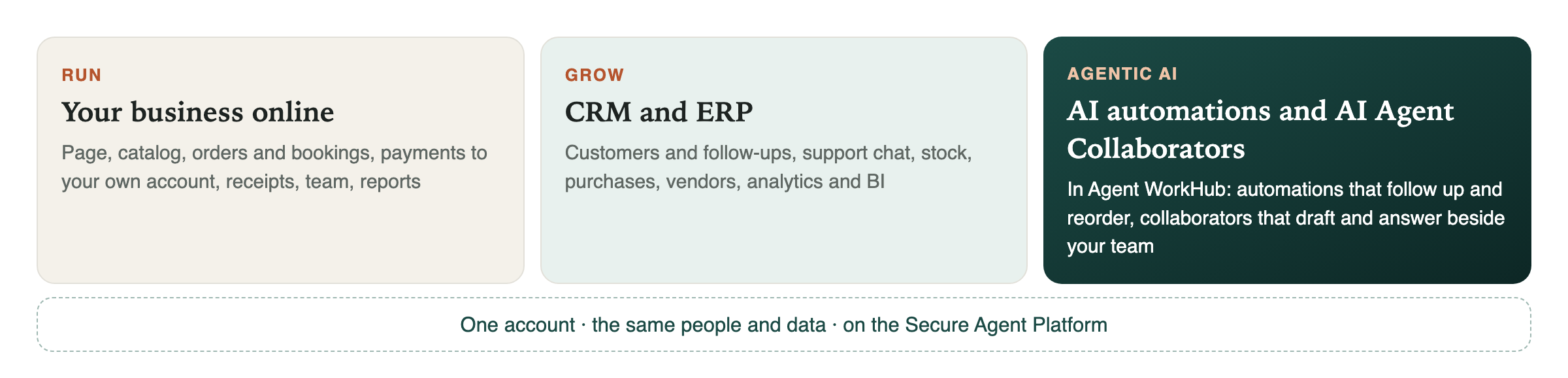
Built on the Secure Agent Platform
Security and privacy are made once, in one core, and kept for every business. It is the reason the platform exists.
- Security: passkey sign-in after the first visit, so there is no password to steal; every request is checked for who is asking.
- Privacy: each business's data kept apart, only what is needed collected, and old details deleted on a schedule; designed with each country's law in mind, such as Singapore's PDPA and Australia's Privacy Act and Australian Privacy Principles.
- Trust and audit: a tamper-evident record of every change: who, what and when.
- Safe AI: agents act only within the permissions the owner grants, and the owner chooses which actions need approval.
- Payments you own: customers pay the business directly; the platform never holds the money.
- Web and apps: the web on any phone or laptop, and iPhone and Android apps on the same core.
Why ebz.app
- Your address, your brand. A page of your own at ebz.app/your-name, not a listing among competitors.
- Your money, straight to you. No commission, no card fees, and nothing held by the platform.
- Your customers and data. Downloadable at any time, and kept even if the business pauses.
- Set up in one sitting. Five steps on a phone, with no installation and no approval wait.
- Ready for your country. Tax lines, license numbers, payment methods and legal terms come in a country pack.
- Grows with you. The same account adds CRM, ERP and AI collaborators; nothing is re-entered.
- Secure by design. Passkeys, separated data and a full audit trail from day one.
Start free
Every business gets 30 days free from the day it starts, with no card needed and no approval wait. From day 3 the owner can ask for more time. Nothing is ever charged automatically, and if the time runs out the business is paused, never deleted: its public pages close, and the owner keeps Admin and every record.

Product specifications
For technical readers, partners and reviewers: how ebz.app is built and run.
- Delivery: hosted web service, phone-first, nothing to install; the same core serves iPhone and Android apps.
- Addresses: one website, ebz.app, with every business at ebz.app/handle on the same origin.
- Countries: Singapore, Malaysia, the United States, India and Australia, each with its own landing page, country pack, payment methods and legal terms.
- Kinds of business: kind profiles on one shared engine, opened country by country.
- Sign-in: passkeys (WebAuthn) first; email one-time codes; Google sign-in that asks for the email address only; staff on their own logins or a tablet PIN. No passwords are stored.
- Data separation: every record carries its business (its tenant), and the platform core refuses any read or write across businesses before product code runs.
- Payments: direct to the business on local rails, confirmed by staff, with a fresh passkey required to change where money goes.
- Legal and consent: Terms of Service, Privacy Notice and Customer notice per country, with the accepted versions recorded per business.
- Hosting: Cloudflare Workers on Cloudflare's worldwide network, the D1 database, R2 storage for photos on media.ebz.app, and Amazon SES for sign-in codes.
- Portability: the same software is tested on Amazon Web Services' database.
- Controls: a pause per business and a whole-site switch, both reversible in seconds.
- Release: three places (local, preview.ebz.app and the public site) and one gated release command.
- Quality: a full automated test gate before every change, including attack tests and race tests.
What a visitor sees
- Landing pages by country for Singapore, Malaysia, the United States, India and Australia, with a country picker, local payment methods and the promise "No card needed, and no approval wait."
- Business addresses such as ebz.app/kaveritraders. Each name, called a handle, is unique across the whole service, 3 to 30 letters and digits, and can never be a word the platform needs for itself, such as "admin" or "terms".
- Admin under the business's own address, with a go-live checklist, a "days free left" card, and "Request more time" from day 3.
- Legal pages at ebz.app/terms and ebz.app/privacy in each country's version, plus a short privacy notice on every business's own page for its customers.
- A "Not open yet" page for any business that is not public, because it is still setting up or is paused.
Architecture
One Cloudflare Worker serves every kind of business on one origin. When someone opens ebz.app/kaveritraders, the Worker looks up the handle in its directory, finds which kind of business it is, runs the request through the platform's security checks, and hands it to that kind's pages: a wholesaler's catalog and quotation request, a travel agent's packages, a school's courses, or a shop's products. Keeping everything on one address keeps sign-in simple, because one passkey works everywhere, and lets the strictest web security rules apply to every page at once.
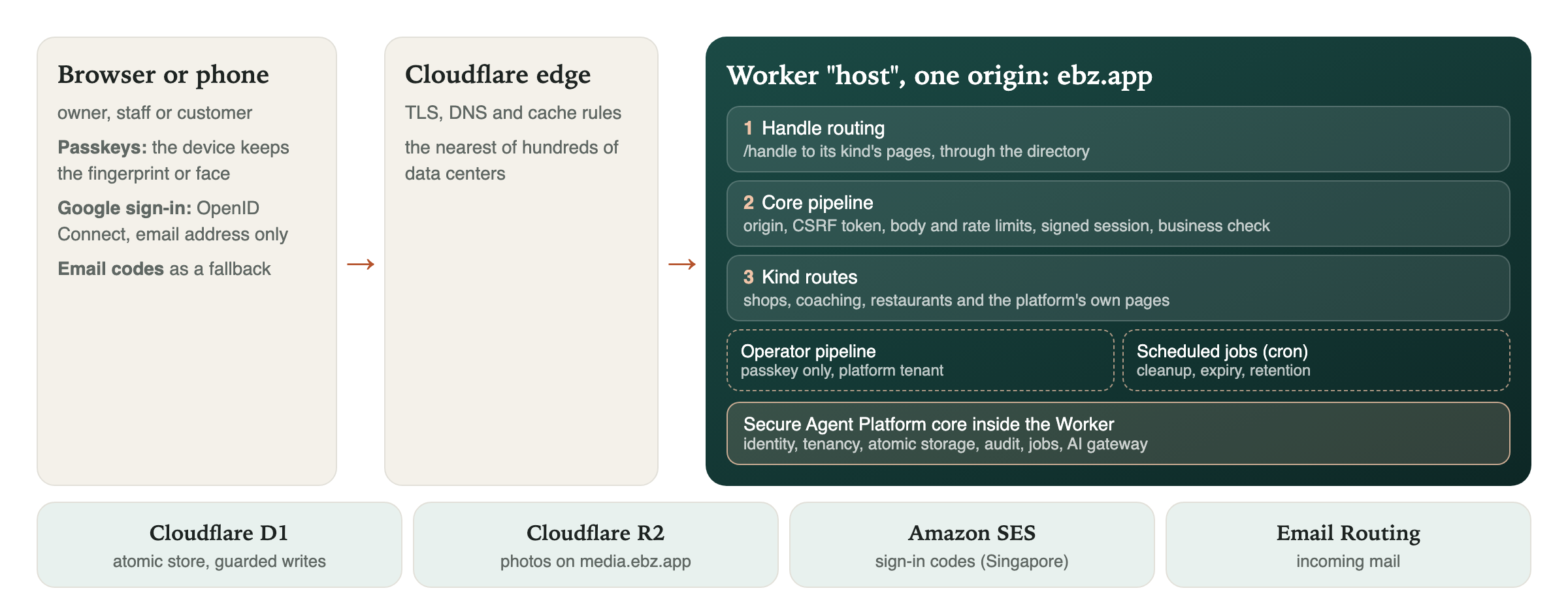
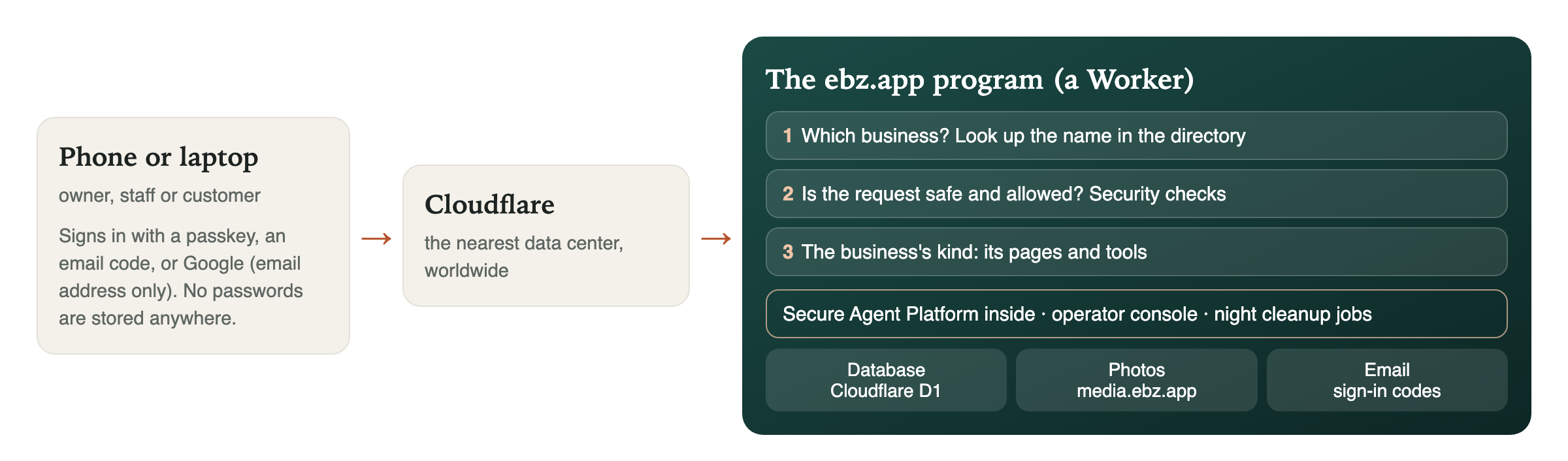
Why Cloudflare? Instead of one server in one city, Cloudflare runs the program in hundreds of data centers worldwide, so a customer in Chennai and one in Sydney both get a fast page. There is no server to patch or restart, and the running cost stays low. Photos are served from a separate origin, media.ebz.app, so a picture can never run script on the main site.
How every request is checked
Each request passes the same checks, in the same order, whatever page it reaches:
- Origin: for every write, the request must come from ebz.app itself.
- Token: every write carries a CSRF token from the signed-in page, so a malicious website cannot click buttons on the owner's behalf.
- Limits: each route has a body-size limit and a rate limit per internet address, with IPv6 addresses grouped by /64 so one network cannot hide behind many addresses.
- Session: the signed-in person comes from a signed cookie, and the session records how they signed in, so money actions can demand a fresh passkey.
- Business: every row carries its business, and the core refuses a read or write that crosses businesses before any product code runs.
The operator's own routes run on a separate pipeline that admits only a passkey sign-in into the platform's own tenant, so no business account can ever reach them.
Keeping every business separate and safe
Many businesses share the same database. Every record is stamped with the business it belongs to. Think of an apartment block where every door checks your key, not just the main entrance.
- Authentication: passkeys first; email codes limited to five an hour per address; Google sign-in that asks for the email address only; money changes need a fresh passkey. Stops password theft and guessing.
- Isolation: the business on every row, checked by the core; capability links, such as a table QR code or an order key, carry only the rights their purpose lists. Stops a leaked link becoming a master key.
- Web hardening: a strict Content Security Policy with the media origin as the only extra image source; SameSite cookies; an origin check and a CSRF token on every write; no owner-supplied HTML or script. Stops malicious sites acting for a user, and hidden scripts inside images.
- Abuse limits: per-route body limits and rate limits; handle lookups limited before the database is read; daily registration caps. Stops floods and scraping.
- Privacy: customer contact details erased after the retention period by a scheduled job; sealed, per-field encrypted notes; logs that carry fixed codes, never personal values. Stops personal data being kept or exposed longer than needed.
- Kill switches: a pause per business and one for the whole site, both reversible. Stops ongoing harm while a problem is fixed.
One-door links in practice. A QR code on a counter, a table, a brochure or an invoice lets a customer do exactly one thing, such as view the catalog and place an order. After ordering or booking, the customer gets a private link that shows only their own transaction.
The life of a business on the service
One rule, called entryOpen, decides whether a business is open to the public: approved, not paused, and inside its free time. Every public path asks it: the directory, the business page, the privacy notice, the coaching site, and the order routes behind table QR codes, so a printed QR code of a paused business cannot place an order. Admin never asks it, so the owner can always sign in, download data and ask for more time.
The operator's console
Someone has to run the service: approve new businesses, help owners get started, and stop trouble quickly. That is the operator. The operator signs in only with a passkey and sees one live table of every business, each with its status and the one thing to do about it. For example:
- Kaveri Traders has asked for more time: Approve more time, or Decline.
- Bright Minds Tuition is ready, but its owner has not signed up yet: Make the invite.
- Lim & Rao Home is open to the public: nothing to do, with Pause available.
Each change is one database commit holding the change and its audit record together, so a record can never exist without its action or the other way round. A second click arriving at the same moment gets "busy" rather than a double change. If the operator's last passkey sign-in is older than 15 minutes, the console asks for it again before changing anything. For emergencies, a whole-site switch answers every request with "Service paused", and it can be undone in seconds. The console shows business facts only (name, kind, country, dates and status), never owners' emails or customers' details.
Legal terms and consent in five countries
Each country has its own Terms of Service, Privacy Notice and short Customer notice, reflecting local law: Singapore's PDPA, Malaysia's PDPA, US state laws such as California's, India's DPDP Act and Australia's Privacy Act. The documents are written once in Markdown, a build tool turns them into page data, and a test fails if the two ever drift apart. Operator details are tokens filled from one setting, so they never differ between documents. When a business registers, the versions it accepted are recorded. When the terms change (version 1.1 added the 30-day free period), every existing owner sees a small screen once, "We updated our Terms of Service", and agrees before Admin opens.
Release engineering
The service runs in three places: a local copy on the developer's computer, a preview site (preview.ebz.app, never indexed by search engines) and the public site. Moving a change to the public site is one command, which deploys only from a clean checkout exactly at the main branch and stops at the first failure.
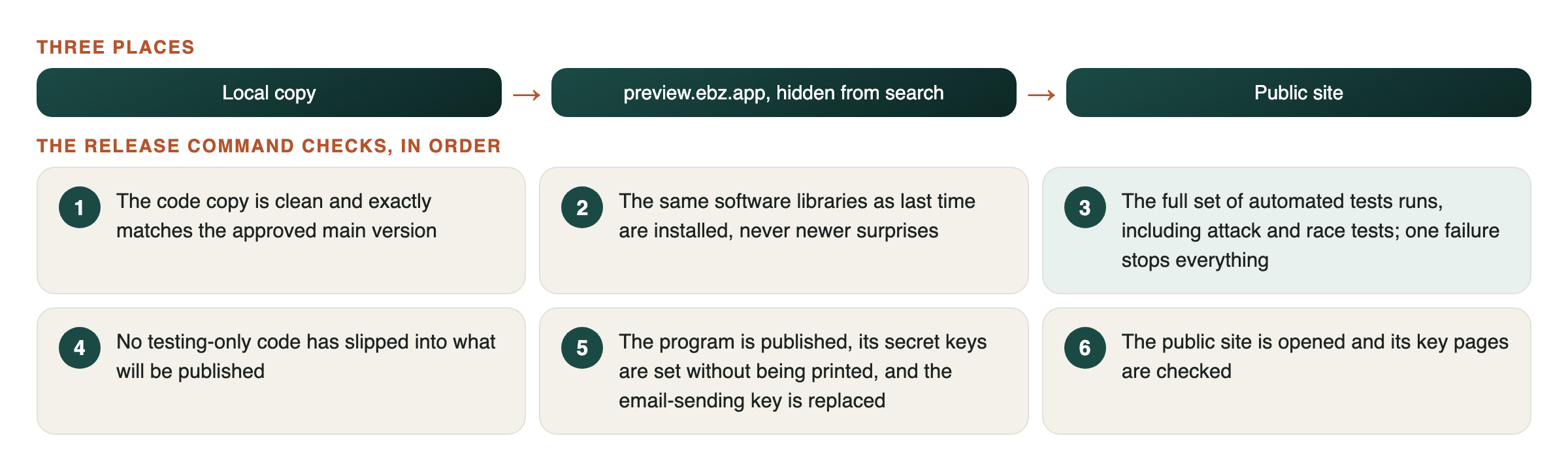
The command installs the locked package versions, runs the full test gate, runs a preflight that refuses any test-only code in the bundle, deploys the Worker together with its domains and its scheduled (cron) trigger, sets the secrets without ever printing them, rotates the email-sending key, and smoke-tests the public address. Hosted continuous integration runs only when a pull request is labeled ready to merge, which keeps it fast and inexpensive.
Technical stack
- Language: TypeScript in strict mode, with erasable syntax run directly by Node 22 for tests (node:test), and npm workspaces.
- Bundling and deploys: esbuild bundles, and Wrangler driven by the gated release command.
- Runtime: Cloudflare Workers, one Worker on one origin with a scheduled trigger for nightly jobs.
- Data: Cloudflare D1 (SQLite at the edge) through the platform's atomic store, with guarded writes that state the revision they expect.
- Media: Cloudflare R2 on a separate origin, media.ebz.app.
- Email: Cloudflare Email Routing for incoming mail, and Amazon SES (Singapore region) for sign-in codes.
- Identity: WebAuthn passkeys, email one-time codes, and Google sign-in through OpenID Connect.
- Platform: the Secure Agent Platform core inside the Worker: identity, tenancy, storage, audit, jobs and the AI gateway.
- Portability: a tested Amazon Web Services adapter (DynamoDB) behind the same platform contract.
- CI: GitHub Actions, gated on the ready-to-merge label.
- Way of building: AI-native engineering with two builders on one written contract: Codex builds the platform core and Claude builds the products, each reviewing the other.
Questions a new reader often asks
Does ebz.app take a cut of my sales?
No. Customers pay the business directly on local payment rails, and ebz.app never holds the money or charges card fees.
What happens to my data if I stop?
Nothing is deleted when a business is paused. The owner can sign in, download everything, and ask to continue. Closing a business gives 30 days to download data before it is deleted, with notice first.
Can the operator see my customers?
No. The operator's console shows business facts only: name, kind, country, dates and status. It does not list owners' emails or customers' details.
Can I use it on my phone?
Yes. Every screen is designed phone-first, with no sideways scrolling and touch targets sized for a thumb.
What if Cloudflare has an outage?
The service runs across Cloudflare's network of hundreds of data centers, and the data is built to be portable: the same software is tested on Amazon Web Services' database.
Can I use my own domain?
The shared address keeps sign-in simple and lets the strictest security rules cover every page. For an owner who wants their own name in the address bar, a custom domain can sit in front, with ebz.app running behind it.
Glossary
- Handle: a business's unique short name in its address, as in ebz.app/handle.
- Kind: the type of business, which sets its screens, words and starter catalog.
- Passkey: sign-in with fingerprint or face; nothing secret is stored on the server.
- Operator: the person who runs the service and its console.
- Preview site: a private copy of the service used to test changes before the public site.
- Worker: a program that runs inside Cloudflare's data centers, close to each visitor.
- Tenant: one business's own space in the shared database.
- Capability link: a link or QR code that carries only the rights its one purpose needs.
- CSRF token: a secret from the signed-in page that proves a change came from ebz.app itself.
- Kill switch: a quick, reversible way to pause one business or the whole site.
Companion articles: "Ebiz Suite", the product, and "Secure Agent Platform", the foundation. Business names and figures in the examples are fictional. © 2026 Srini Ramakichenane, Singapore.